Oil prices briefly returned to pre-war levels, but the risk of a sharp rise remains high.
2026-07-08 13:52:09
With the US and Iran reaching a framework agreement on resuming navigation and shipping gradually returning to the Strait of Hormuz, Brent crude oil prices recently fell back to pre-conflict levels. Major market institutions currently predict that the resumption of Middle Eastern crude oil exports will reshape the global supply and demand landscape, potentially leading to a large-scale crude oil oversupply in 2027, with oil prices expected to drop to $60 per barrel by the end of the year.
Beneath the seemingly relaxed market surface lie hidden structural risks. Global crude oil inventories are at multi-decade lows, with a lengthy restocking cycle. Coupled with the unresolved US-Iran negotiations and the high probability of continued tensions, the crude oil market still faces a new round of supply shocks and price rebounds at any time. On Tuesday (July 7), several oil tankers were attacked in the Strait of Hormuz, followed by US airstrikes against Iran, causing Brent crude oil to rise 5.41% that day.
After the US and Iran finalized the plan to restart shipping routes, the geopolitical risk premium that had previously driven up oil prices quickly subsided, the circulation order of crude oil in the Middle East gradually recovered, and the temporary supply shortage was completely reversed.
Speculative funds in the market have collectively shifted to short positions over the past month, with trading institutions generally believing that the crisis of oil shortages and shipping disruptions has ended. Multiple investment banks and trading markets unanimously predict that as shipping capacity in the Strait of Hormuz continues to recover, global oil supply will rapidly ease, forming a full-blown surplus as early as 2027, driving oil prices down further, with $60 per barrel becoming the mainstream target price at the end of the year.
Current market pricing in short positions generally assumes the US-Iran memorandum of understanding will translate into a long-term peace agreement, but actual progress is far from material. The two sides have only reached a framework agreement to begin formal negotiations by the end of August, with no publicly disclosed substantive progress at this stage, and the regional situation could deteriorate again at any time. Iran continues to insist on maintaining control over the Strait of Hormuz and plans to charge transit fees to ships. Meanwhile, the US's push for the agreement has clear political motives, aiming to lower oil prices to support the midterm elections; it will likely need to make policy concessions later, and this round of negotiations has completely failed to address the core disagreement over the Iranian nuclear issue.
Shipping is currently recovering at a slow pace, and shipyards are generally maintaining a cautious wait-and-see attitude, making it difficult to guarantee the stability of navigation.
This unprecedented disruption to crude oil supply did not trigger extreme market conditions thanks to multiple phased buffer mechanisms. The United States and other countries released strategic crude oil reserves, pushing global inventories to decades-low levels. After oil prices surged in the early stages of the conflict, major Asian countries holding over 1.3 billion barrels of commercial and strategic reserves promptly suspended spot purchases, stabilizing market volatility. Furthermore, the crude oil market was already in a loose state before the conflict, with ample floating storage at sea.
Ilia Bouchouev, a scholar at the Oxford Institute for Energy Studies, said that while ultra-low inventories do not affect the basic operation of the market, they will greatly amplify the volatility of oil prices, and long-term prices are very likely to surge due to supply disruptions.
Analysts from energy research firms stated at the end of June that global crude oil buffer inventories are currently severely insufficient, and the market's ability to withstand geopolitical shocks is at a historically weak level. The US strategic petroleum reserve has hit a new low since 1985, with no surplus inventory to offset the risk of demand recovery or supply disruptions.
Data from shipping data agency Vortexa shows that crude oil arrivals in major Asian countries fell for the fourth consecutive month in June, with the average daily arrivals dropping to the lowest level since 2016.
Pamela Munger, head of market analysis for Europe, the Middle East, and Africa at an agency, stated that the current decline in imports includes short-term factors and is not a complete structural contraction. The country's crude oil purchasing demand will gradually recover. Overall, restocking in Asia will proceed at a steady and gradual pace, without any concentrated large-scale purchases. Before global inventories are fully restored, any fluctuations in the US-Iran situation, the negotiation process, and sanctions policies will quickly disrupt the supply-demand balance and trigger another surge in oil prices.
Overall, the fading geopolitical risks and the recovery in supply are driving the downward trend in oil prices in the short term, with oversupply pressure continuing to suppress market prices in 2027. However, ultra-low inventory levels, the unresolved US-Iran agreement, and recovering demand from major Asian countries collectively provide support for oil prices at their bottom, while also presenting potential upside risks.
The current crude oil market is in a state of weak equilibrium, with limited downside potential and increased volatility. Until the geopolitical situation is completely stabilized and global inventories are fully restored, the two-way fluctuation of oil prices will continue for a long time.
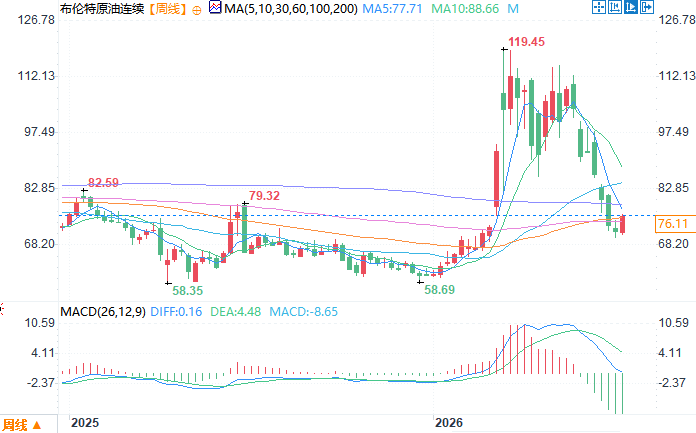
Brent crude oil weekly chart source: EasyForex
At 13:25 Beijing time on July 8, Brent crude oil futures were trading at $76.53 per barrel.
Beneath the seemingly relaxed market surface lie hidden structural risks. Global crude oil inventories are at multi-decade lows, with a lengthy restocking cycle. Coupled with the unresolved US-Iran negotiations and the high probability of continued tensions, the crude oil market still faces a new round of supply shocks and price rebounds at any time. On Tuesday (July 7), several oil tankers were attacked in the Strait of Hormuz, followed by US airstrikes against Iran, causing Brent crude oil to rise 5.41% that day.
With geopolitical risks receding, bearish sentiment briefly dominated short-term oil price movements.
After the US and Iran finalized the plan to restart shipping routes, the geopolitical risk premium that had previously driven up oil prices quickly subsided, the circulation order of crude oil in the Middle East gradually recovered, and the temporary supply shortage was completely reversed.
Speculative funds in the market have collectively shifted to short positions over the past month, with trading institutions generally believing that the crisis of oil shortages and shipping disruptions has ended. Multiple investment banks and trading markets unanimously predict that as shipping capacity in the Strait of Hormuz continues to recover, global oil supply will rapidly ease, forming a full-blown surplus as early as 2027, driving oil prices down further, with $60 per barrel becoming the mainstream target price at the end of the year.
Significant uncertainties remain regarding the negotiation framework, and geopolitical tail risks have not yet been eliminated.
Current market pricing in short positions generally assumes the US-Iran memorandum of understanding will translate into a long-term peace agreement, but actual progress is far from material. The two sides have only reached a framework agreement to begin formal negotiations by the end of August, with no publicly disclosed substantive progress at this stage, and the regional situation could deteriorate again at any time. Iran continues to insist on maintaining control over the Strait of Hormuz and plans to charge transit fees to ships. Meanwhile, the US's push for the agreement has clear political motives, aiming to lower oil prices to support the midterm elections; it will likely need to make policy concessions later, and this round of negotiations has completely failed to address the core disagreement over the Iranian nuclear issue.
Shipping is currently recovering at a slow pace, and shipyards are generally maintaining a cautious wait-and-see attitude, making it difficult to guarantee the stability of navigation.
Multiple buffering factors support the market, but extremely low inventory levels may conceal a surge in prices.
This unprecedented disruption to crude oil supply did not trigger extreme market conditions thanks to multiple phased buffer mechanisms. The United States and other countries released strategic crude oil reserves, pushing global inventories to decades-low levels. After oil prices surged in the early stages of the conflict, major Asian countries holding over 1.3 billion barrels of commercial and strategic reserves promptly suspended spot purchases, stabilizing market volatility. Furthermore, the crude oil market was already in a loose state before the conflict, with ample floating storage at sea.
Ilia Bouchouev, a scholar at the Oxford Institute for Energy Studies, said that while ultra-low inventories do not affect the basic operation of the market, they will greatly amplify the volatility of oil prices, and long-term prices are very likely to surge due to supply disruptions.
Analysts from energy research firms stated at the end of June that global crude oil buffer inventories are currently severely insufficient, and the market's ability to withstand geopolitical shocks is at a historically weak level. The US strategic petroleum reserve has hit a new low since 1985, with no surplus inventory to offset the risk of demand recovery or supply disruptions.
Demand in major Asian countries is gradually recovering, and the pace of restocking will influence medium- to long-term oil prices.
Data from shipping data agency Vortexa shows that crude oil arrivals in major Asian countries fell for the fourth consecutive month in June, with the average daily arrivals dropping to the lowest level since 2016.
Pamela Munger, head of market analysis for Europe, the Middle East, and Africa at an agency, stated that the current decline in imports includes short-term factors and is not a complete structural contraction. The country's crude oil purchasing demand will gradually recover. Overall, restocking in Asia will proceed at a steady and gradual pace, without any concentrated large-scale purchases. Before global inventories are fully restored, any fluctuations in the US-Iran situation, the negotiation process, and sanctions policies will quickly disrupt the supply-demand balance and trigger another surge in oil prices.
Summarize
Overall, the fading geopolitical risks and the recovery in supply are driving the downward trend in oil prices in the short term, with oversupply pressure continuing to suppress market prices in 2027. However, ultra-low inventory levels, the unresolved US-Iran agreement, and recovering demand from major Asian countries collectively provide support for oil prices at their bottom, while also presenting potential upside risks.
The current crude oil market is in a state of weak equilibrium, with limited downside potential and increased volatility. Until the geopolitical situation is completely stabilized and global inventories are fully restored, the two-way fluctuation of oil prices will continue for a long time.
Brent crude oil weekly chart source: EasyForex
At 13:25 Beijing time on July 8, Brent crude oil futures were trading at $76.53 per barrel.
- Risk Warning and Disclaimer
- The market involves risk, and trading may not be suitable for all investors. This article is for reference only and does not constitute personal investment advice, nor does it take into account certain users’ specific investment objectives, financial situation, or other needs. Any investment decisions made based on this information are at your own risk.