Gold Trading Alert: Amidst the interplay of gunfire and interest rate hike expectations, gold prices narrowly rebounded to $4,100. Is this a rebound or a trap?
2026-07-10 07:32:44
On July 9th, the international gold market witnessed a dramatic reversal. After three consecutive days of decline, spot gold rebounded strongly on Thursday (July 9th), rising by more than 1% and regaining the important $4,100 per ounce mark. The previous day (Wednesday), gold prices had just fallen to their lowest point since July 1st—$4,021.70 per ounce. As of the close of trading in New York on Thursday, spot gold was at $4,123.83 per ounce, with an intraday trading range of $4,054.39 to $4,138.06. US gold futures for August delivery rose 1.4%, settling at $4,140.80 per ounce.
Alongside gold, silver, platinum, and palladium also strengthened, with all three rising by more than 3%—this wasn't just gold performing alone, but a collective surge across the entire precious metals sector. Looking at the market, gold opened lower but rallied, briefly dipping to around $4050 in the morning session, with intense battles between bulls and bears. However, the bulls subsequently rallied, not only successfully recovering the previous day's losses but also breaking through the $4100 mark. The single-day rebound from the low to the high exceeded 80 points.
One market strategist bluntly stated, "After Wednesday's decline, some bargain hunters emerged in the market." This assessment accurately captured the core market sentiment—around $4,020, bargain hunters were already starting to stir.
Furthermore, according to two sources from mediating countries and a US official, regional mediators such as Qatar and Pakistan are actively working to ease tensions between the US and Iran, creating space for the resumption of nuclear negotiations. This eased market concerns about the Middle East situation, with oil prices falling sharply on Thursday to alleviate inflation concerns, and the dollar index declining, providing an opportunity for gold prices to rebound.
On the eve of the retaliation, the US launched its second consecutive attack on Iran, targeting Iranian infrastructure including bridges, airports, and ports. Iranian armed forces subsequently retaliated with attacks on US military facilities in the Gulf states. Iran claimed responsibility for attacks on US targets in Kuwait, Qatar, and Bahrain. According to Iranian state media, the US airstrikes resulted in 14 deaths and 78 injuries across five provinces. The tension was further heightened by a more symbolic event—the funeral of Iran's Supreme Leader Ayatollah Khamenei, who was killed in a US airstrike on February 28, the first day of the war. The funeral marked the end of a week-long period of deep mourning.
The U.S. military stated that the core objective of its latest round of strikes was to ensure the Strait of Hormuz remained open to navigation. This followed the U.S. claim that Iranian forces attacked three oil tankers in the region. The U.S. military also stated that U.S. airstrikes hit the outer perimeter of Iran's Bushehr nuclear power plant.
However, the impact of geopolitical conflicts on gold is not as straightforward as the saying "buy gold when there's war." In fact, since the outbreak of the US-Iran conflict, the traditional "safe haven" logic of gold has been rewritten by a more complex transmission mechanism—geopolitical conflicts drive up oil prices, oil prices drive up inflation expectations, and inflation expectations reinforce the necessity for the Federal Reserve to raise interest rates. Interest rate hike expectations are precisely the biggest negative factor suppressing gold, a non-interest-bearing asset. Thus, a seemingly abnormal phenomenon has emerged in the market: the fiercer the war, the higher the oil prices rise, and the more pressure gold faces.
However, the situation in the Middle East appeared to take a turn for the better on Thursday. Trump stated that "Iran called earlier and they want to make a deal." This news quickly ignited the market—geopolitical concerns cooled abruptly.
According to two mediators and a U.S. official, Qatar, Pakistan, and other regional mediators are actively working to ease tensions between the U.S. and Iran, creating space for the resumption of nuclear negotiations. Officials from Qatar, Pakistan, Turkey, Egypt, and Saudi Arabia held multiple phone calls with both the U.S. and Iran on Wednesday in an attempt to stabilize the situation amid the escalating military conflict.
A regional source involved in the mediation stated that the current focus for all parties is on de-escalating the situation, followed by finalizing the timing of the next round of negotiations between the technical teams of both sides. This indicates that the mediators are attempting to pull the US and Iran back from their current tit-for-tat stance to a diplomatic approach. A US official told the media that the Trump administration remains "committed to finding a solution," and technical-level consultations are still underway.
Following this news, oil prices retreated from their intraday highs, with U.S. crude falling approximately 2.65% to $71.57 per barrel and Brent crude dropping approximately 2.95% to $75.72 per barrel. The decline in oil prices cooled inflation expectations, which in turn lowered U.S. Treasury yields and the dollar exchange rate, creating room for a gold rebound. The 10-year U.S. Treasury yield fell nearly 3 basis points to 4.537%, after hitting a seven-week high the previous day; the two-year U.S. Treasury yield fell 3.7 basis points to 4.164%. The dollar index also fell for the second consecutive trading day, declining 0.15% to 100.87.
One industry insider commented, "Interest rates are highly volatile, but we expect them to fall significantly as oil prices decline, as oil prices have been a major driver." He also noted that the Trump administration's "willingness to quickly adjust its stance" helps alleviate market concerns about an escalation of the war.
If geopolitics is the "accelerator" for gold, then the Federal Reserve's monetary policy is the "brake" for gold—and this brake is currently being applied very tightly.
According to market monitoring tools, traders currently expect a 62% probability of a rate hike in September. Although the probability of a July rate hike has fallen from about 31% on Wednesday to around 26%, expectations for a September rate hike remain high. Looking at a more detailed probability distribution, the probability of the Fed keeping rates unchanged by September is 31.1%, the probability of a cumulative 25 basis point rate hike is 51.9%, and the probability of a cumulative 50 basis point rate hike is 17.0%.
Market concerns about interest rate hikes are not unfounded. Minutes from the Federal Reserve's June 16-17 meeting revealed growing concerns among policymakers about high inflation, with some participants believing there was reason to raise rates immediately. This was the first meeting chaired by new Chairman Warsh, and his hawkish tone sent shockwaves through the market. One economist bluntly stated, "The minutes reiterated that the door to a September rate hike remains open."
New York Federal Reserve President Williams said on Thursday that despite renewed hostilities in the Middle East, he does not expect energy prices to continue rising for the remainder of the year. This statement somewhat eased market concerns about runaway inflation and provided a respite for gold's rebound.
Against this backdrop, institutional outlooks for gold have diverged significantly. HSBC on Thursday lowered its average gold price forecasts for 2026 and 2027 to $4,560 and $4,925 per ounce, respectively, from its previous forecasts of $4,864 and $5,000. The bank expects gold to fluctuate between $3,800 and $4,700 for the remainder of 2026. HSBC's chief precious metals analyst, James Steel, stated in a research report: "The price decline this year has exceeded expectations, the Federal Reserve's hawkish shift, and HSBC's foreign exchange research department's expectation of a stronger dollar have prompted us to lower our forecasts."
Bank of America also adjusted its gold price forecast, lowering its 2026 average gold price expectation by 14% to $4,360 per ounce. Deutsche Bank, meanwhile, revised its third-quarter gold price target to $4,300, a reduction of more than one-fifth from its previous forecast.
However, not all institutions are so pessimistic. Commerzbank predicts an average gold price of around $4,631 per ounce in 2026, closing the fourth quarter around $4,800. Craig Hemke, an analyst at Sprott Money, believes the period of weakness in precious metals may be nearing its end, and the Federal Reserve's policy is likely to soon shift towards Warsh's original chosen goal—reducing net interest costs through interest rate cuts. Amundi is even more bullish on gold's medium- to long-term benefits from stagflation and geopolitical uncertainty, forecasting a gold price of $5,500 over the next twelve months.
Despite facing headwinds from short-term interest rate hike expectations, gold is not without its trump cards.
In the medium to long term, structural support such as global central bank gold purchases and the de-dollarization process remains solid. Industry surveys show that 89% of central bank reserve managers expect global central bank gold reserves to continue to increase in the next 12 months. Just this week, the People's Bank of China released its June gold reserve data, showing that official gold reserves increased for the 20th consecutive month, by 480,000 ounces.
Some institutions acknowledge that despite downward revisions to price forecasts, the downside for gold prices may be limited, as the market has largely priced in a stronger dollar and persistently high interest rates. Some fundamental factors that supported gold prices before the Middle East conflict remain, including concerns about fiscal deficits, economic uncertainty, and heavy sovereign debt burdens.
However, short-term negative factors cannot be ignored. In June, global gold-backed ETFs saw outflows of 74.3 tons, equivalent to approximately $8.9 billion, bringing global gold ETF assets under management down 13% to $526 billion. North American gold ETFs experienced outflows of $5.5 billion in June, with net outflows reaching $7.7 billion in the first half of the year, marking the weakest first-half performance since 2013. Some institutions have bluntly stated that the ETF inflows in June signal that gold allocation funds have not yet returned, and the recent rebound is more likely to be defined as a correction after a sharp drop, rather than a new round of proactive allocation.
Other analyses also point out that gold may remain in a low-level consolidation phase in the short term. Repeated geopolitical conflicts provide temporary support, but energy inflation and hawkish expectations from the Federal Reserve still limit the upside potential. Going forward, key factors to watch include the evolution of the US-Iran conflict, oil price changes, statements from Federal Reserve officials, and the trends of the US dollar index and US Treasury yields.
Looking ahead, the direction of the gold market will depend primarily on three key variables.
The first variable is the direction of geopolitical development. Whether the US-Iran conflict continues to escalate or de-escalates will directly determine the trend of oil prices, thereby affecting inflation expectations and the Federal Reserve's policy path. If the conflict escalates again, oil prices may surge further, inflationary pressures will intensify, expectations of a Fed rate hike will rise, and gold will face greater downward pressure. Conversely, if the situation eases, oil prices will fall, interest rate pressures will ease marginally, and gold may have a chance to recover from its lows. It is worth noting that after Iran launched its attack, Trump stated that Iran had proactively contacted the US to seek an agreement, which to some extent alleviated market concerns about further deterioration of the situation.
The second variable is US economic data, especially inflation data. Investors will be closely watching next week's inflation data and Federal Reserve Chairman Warsh's testimony before Congress. The market's next focus will be the US CPI data released on July 14, the most important inflation data before the July interest rate meeting. If the CPI continues to decline, it will confirm the economic slowdown reflected in the non-farm payrolls, and market expectations for interest rate hikes are likely to be further revised, leaving room for further recovery in gold prices; if inflation remains resilient, expectations of high interest rates may rise, limiting the upside potential for gold.
The third variable is the Federal Reserve's policy signals. Warsh's testimony to Congress will provide more clues about the direction of monetary policy. Currently, the market still expects the Fed to raise rates once this year, but expectations for rate cuts have not significantly increased. The market is pricing in a "slowing of the tightening trade" rather than "expectations of easing," and this difference in judgment will determine the direction of gold's medium-term trend.
From a technical perspective, although gold prices touched a two-day high of $4,138, the overall trend remains bearish. Short-term momentum has turned bullish, but for bulls to confirm the end of the downtrend, gold prices need to break through the downtrend resistance line in the $4,190 to $4,215 area.
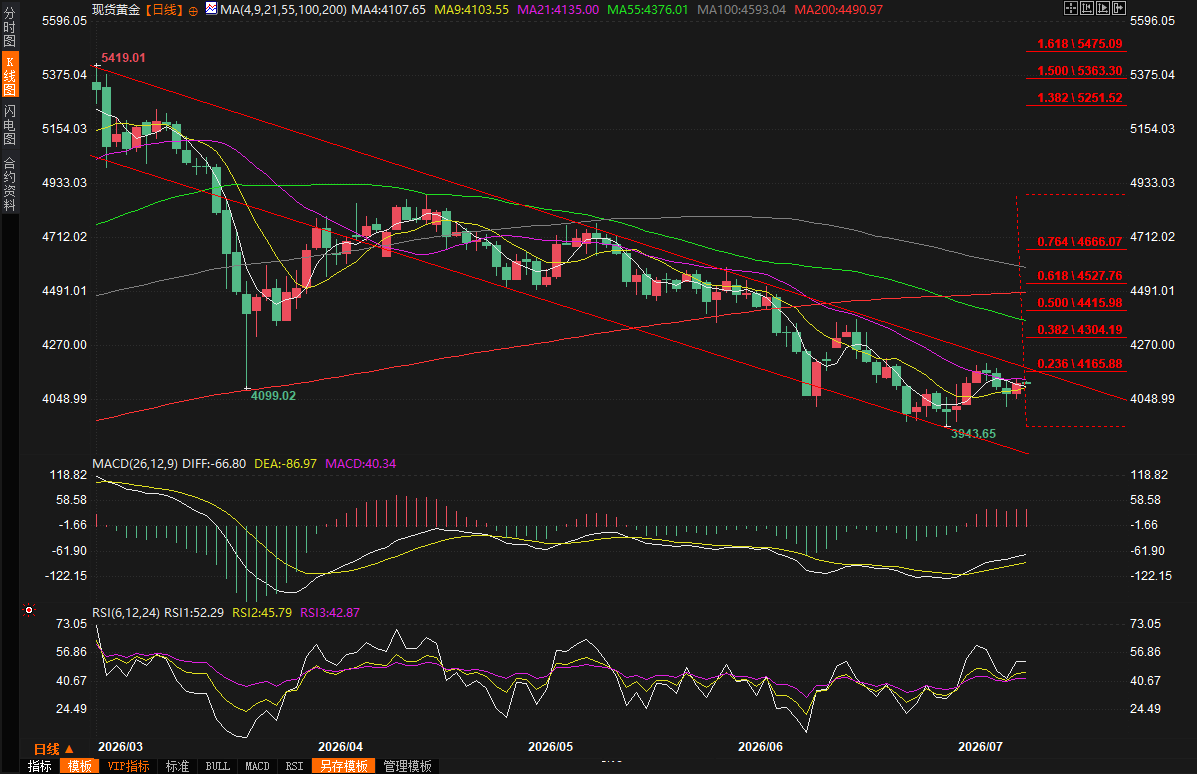
(Spot gold daily chart, source: FX678)
At 07:28 Beijing time, spot gold was trading at $4122.91 per ounce.
Alongside gold, silver, platinum, and palladium also strengthened, with all three rising by more than 3%—this wasn't just gold performing alone, but a collective surge across the entire precious metals sector. Looking at the market, gold opened lower but rallied, briefly dipping to around $4050 in the morning session, with intense battles between bulls and bears. However, the bulls subsequently rallied, not only successfully recovering the previous day's losses but also breaking through the $4100 mark. The single-day rebound from the low to the high exceeded 80 points.
One market strategist bluntly stated, "After Wednesday's decline, some bargain hunters emerged in the market." This assessment accurately captured the core market sentiment—around $4,020, bargain hunters were already starting to stir.
Furthermore, according to two sources from mediating countries and a US official, regional mediators such as Qatar and Pakistan are actively working to ease tensions between the US and Iran, creating space for the resumption of nuclear negotiations. This eased market concerns about the Middle East situation, with oil prices falling sharply on Thursday to alleviate inflation concerns, and the dollar index declining, providing an opportunity for gold prices to rebound.
The butterfly effect of geopolitics
On the eve of the retaliation, the US launched its second consecutive attack on Iran, targeting Iranian infrastructure including bridges, airports, and ports. Iranian armed forces subsequently retaliated with attacks on US military facilities in the Gulf states. Iran claimed responsibility for attacks on US targets in Kuwait, Qatar, and Bahrain. According to Iranian state media, the US airstrikes resulted in 14 deaths and 78 injuries across five provinces. The tension was further heightened by a more symbolic event—the funeral of Iran's Supreme Leader Ayatollah Khamenei, who was killed in a US airstrike on February 28, the first day of the war. The funeral marked the end of a week-long period of deep mourning.
The U.S. military stated that the core objective of its latest round of strikes was to ensure the Strait of Hormuz remained open to navigation. This followed the U.S. claim that Iranian forces attacked three oil tankers in the region. The U.S. military also stated that U.S. airstrikes hit the outer perimeter of Iran's Bushehr nuclear power plant.
However, the impact of geopolitical conflicts on gold is not as straightforward as the saying "buy gold when there's war." In fact, since the outbreak of the US-Iran conflict, the traditional "safe haven" logic of gold has been rewritten by a more complex transmission mechanism—geopolitical conflicts drive up oil prices, oil prices drive up inflation expectations, and inflation expectations reinforce the necessity for the Federal Reserve to raise interest rates. Interest rate hike expectations are precisely the biggest negative factor suppressing gold, a non-interest-bearing asset. Thus, a seemingly abnormal phenomenon has emerged in the market: the fiercer the war, the higher the oil prices rise, and the more pressure gold faces.
However, the situation in the Middle East appeared to take a turn for the better on Thursday. Trump stated that "Iran called earlier and they want to make a deal." This news quickly ignited the market—geopolitical concerns cooled abruptly.
According to two mediators and a U.S. official, Qatar, Pakistan, and other regional mediators are actively working to ease tensions between the U.S. and Iran, creating space for the resumption of nuclear negotiations. Officials from Qatar, Pakistan, Turkey, Egypt, and Saudi Arabia held multiple phone calls with both the U.S. and Iran on Wednesday in an attempt to stabilize the situation amid the escalating military conflict.
A regional source involved in the mediation stated that the current focus for all parties is on de-escalating the situation, followed by finalizing the timing of the next round of negotiations between the technical teams of both sides. This indicates that the mediators are attempting to pull the US and Iran back from their current tit-for-tat stance to a diplomatic approach. A US official told the media that the Trump administration remains "committed to finding a solution," and technical-level consultations are still underway.
Following this news, oil prices retreated from their intraday highs, with U.S. crude falling approximately 2.65% to $71.57 per barrel and Brent crude dropping approximately 2.95% to $75.72 per barrel. The decline in oil prices cooled inflation expectations, which in turn lowered U.S. Treasury yields and the dollar exchange rate, creating room for a gold rebound. The 10-year U.S. Treasury yield fell nearly 3 basis points to 4.537%, after hitting a seven-week high the previous day; the two-year U.S. Treasury yield fell 3.7 basis points to 4.164%. The dollar index also fell for the second consecutive trading day, declining 0.15% to 100.87.
One industry insider commented, "Interest rates are highly volatile, but we expect them to fall significantly as oil prices decline, as oil prices have been a major driver." He also noted that the Trump administration's "willingness to quickly adjust its stance" helps alleviate market concerns about an escalation of the war.
The Fed's Hawkish Claws: The Shadow of Interest Rate Hikes Has Never Gone
If geopolitics is the "accelerator" for gold, then the Federal Reserve's monetary policy is the "brake" for gold—and this brake is currently being applied very tightly.
According to market monitoring tools, traders currently expect a 62% probability of a rate hike in September. Although the probability of a July rate hike has fallen from about 31% on Wednesday to around 26%, expectations for a September rate hike remain high. Looking at a more detailed probability distribution, the probability of the Fed keeping rates unchanged by September is 31.1%, the probability of a cumulative 25 basis point rate hike is 51.9%, and the probability of a cumulative 50 basis point rate hike is 17.0%.
Market concerns about interest rate hikes are not unfounded. Minutes from the Federal Reserve's June 16-17 meeting revealed growing concerns among policymakers about high inflation, with some participants believing there was reason to raise rates immediately. This was the first meeting chaired by new Chairman Warsh, and his hawkish tone sent shockwaves through the market. One economist bluntly stated, "The minutes reiterated that the door to a September rate hike remains open."
New York Federal Reserve President Williams said on Thursday that despite renewed hostilities in the Middle East, he does not expect energy prices to continue rising for the remainder of the year. This statement somewhat eased market concerns about runaway inflation and provided a respite for gold's rebound.
Against this backdrop, institutional outlooks for gold have diverged significantly. HSBC on Thursday lowered its average gold price forecasts for 2026 and 2027 to $4,560 and $4,925 per ounce, respectively, from its previous forecasts of $4,864 and $5,000. The bank expects gold to fluctuate between $3,800 and $4,700 for the remainder of 2026. HSBC's chief precious metals analyst, James Steel, stated in a research report: "The price decline this year has exceeded expectations, the Federal Reserve's hawkish shift, and HSBC's foreign exchange research department's expectation of a stronger dollar have prompted us to lower our forecasts."
Bank of America also adjusted its gold price forecast, lowering its 2026 average gold price expectation by 14% to $4,360 per ounce. Deutsche Bank, meanwhile, revised its third-quarter gold price target to $4,300, a reduction of more than one-fifth from its previous forecast.
However, not all institutions are so pessimistic. Commerzbank predicts an average gold price of around $4,631 per ounce in 2026, closing the fourth quarter around $4,800. Craig Hemke, an analyst at Sprott Money, believes the period of weakness in precious metals may be nearing its end, and the Federal Reserve's policy is likely to soon shift towards Warsh's original chosen goal—reducing net interest costs through interest rate cuts. Amundi is even more bullish on gold's medium- to long-term benefits from stagflation and geopolitical uncertainty, forecasting a gold price of $5,500 over the next twelve months.
Structural support and short-term headwinds
Despite facing headwinds from short-term interest rate hike expectations, gold is not without its trump cards.
In the medium to long term, structural support such as global central bank gold purchases and the de-dollarization process remains solid. Industry surveys show that 89% of central bank reserve managers expect global central bank gold reserves to continue to increase in the next 12 months. Just this week, the People's Bank of China released its June gold reserve data, showing that official gold reserves increased for the 20th consecutive month, by 480,000 ounces.
Some institutions acknowledge that despite downward revisions to price forecasts, the downside for gold prices may be limited, as the market has largely priced in a stronger dollar and persistently high interest rates. Some fundamental factors that supported gold prices before the Middle East conflict remain, including concerns about fiscal deficits, economic uncertainty, and heavy sovereign debt burdens.
However, short-term negative factors cannot be ignored. In June, global gold-backed ETFs saw outflows of 74.3 tons, equivalent to approximately $8.9 billion, bringing global gold ETF assets under management down 13% to $526 billion. North American gold ETFs experienced outflows of $5.5 billion in June, with net outflows reaching $7.7 billion in the first half of the year, marking the weakest first-half performance since 2013. Some institutions have bluntly stated that the ETF inflows in June signal that gold allocation funds have not yet returned, and the recent rebound is more likely to be defined as a correction after a sharp drop, rather than a new round of proactive allocation.
Other analyses also point out that gold may remain in a low-level consolidation phase in the short term. Repeated geopolitical conflicts provide temporary support, but energy inflation and hawkish expectations from the Federal Reserve still limit the upside potential. Going forward, key factors to watch include the evolution of the US-Iran conflict, oil price changes, statements from Federal Reserve officials, and the trends of the US dollar index and US Treasury yields.
V. Market Outlook: Three Major Variables to Determine Gold Price Trends
Looking ahead, the direction of the gold market will depend primarily on three key variables.
The first variable is the direction of geopolitical development. Whether the US-Iran conflict continues to escalate or de-escalates will directly determine the trend of oil prices, thereby affecting inflation expectations and the Federal Reserve's policy path. If the conflict escalates again, oil prices may surge further, inflationary pressures will intensify, expectations of a Fed rate hike will rise, and gold will face greater downward pressure. Conversely, if the situation eases, oil prices will fall, interest rate pressures will ease marginally, and gold may have a chance to recover from its lows. It is worth noting that after Iran launched its attack, Trump stated that Iran had proactively contacted the US to seek an agreement, which to some extent alleviated market concerns about further deterioration of the situation.
The second variable is US economic data, especially inflation data. Investors will be closely watching next week's inflation data and Federal Reserve Chairman Warsh's testimony before Congress. The market's next focus will be the US CPI data released on July 14, the most important inflation data before the July interest rate meeting. If the CPI continues to decline, it will confirm the economic slowdown reflected in the non-farm payrolls, and market expectations for interest rate hikes are likely to be further revised, leaving room for further recovery in gold prices; if inflation remains resilient, expectations of high interest rates may rise, limiting the upside potential for gold.
The third variable is the Federal Reserve's policy signals. Warsh's testimony to Congress will provide more clues about the direction of monetary policy. Currently, the market still expects the Fed to raise rates once this year, but expectations for rate cuts have not significantly increased. The market is pricing in a "slowing of the tightening trade" rather than "expectations of easing," and this difference in judgment will determine the direction of gold's medium-term trend.
From a technical perspective, although gold prices touched a two-day high of $4,138, the overall trend remains bearish. Short-term momentum has turned bullish, but for bulls to confirm the end of the downtrend, gold prices need to break through the downtrend resistance line in the $4,190 to $4,215 area.
(Spot gold daily chart, source: FX678)
At 07:28 Beijing time, spot gold was trading at $4122.91 per ounce.
- Risk Warning and Disclaimer
- The market involves risk, and trading may not be suitable for all investors. This article is for reference only and does not constitute personal investment advice, nor does it take into account certain users’ specific investment objectives, financial situation, or other needs. Any investment decisions made based on this information are at your own risk.